
The Venetian Lifeblood: The Complete Guide to the Vaporetto 🚤✨
Venice is a city that defies the logic of the modern world. There are no sirens of ambulances on wheels, no screeching tires, and no asphalt. Instead, there is the gentle lap of the lagoon against Istrian stone. To navigate this floating masterpiece, you must master the Vaporetto.
In this guide, we dive deep into the history, the logistics, and the secrets of Venice’s water bus system—giving you everything you need to travel like a local. 🌊
Book Online – Skip the Line & Travel the Canals
You cannot jump on board without having purchased your ticket in advance. By booking ahead, you bypass the notorious queues that frequently exceed two hours in the heat, saving valuable time for exploration.
Additionally, having your digital QR code ready is now a legal necessity on peak days to comply with the Venice Access Fee regulations, helping you avoid unexpected fines or entry delays at the city’s main checkpoints.
1. What Exactly is a Vaporetto? 🛥️
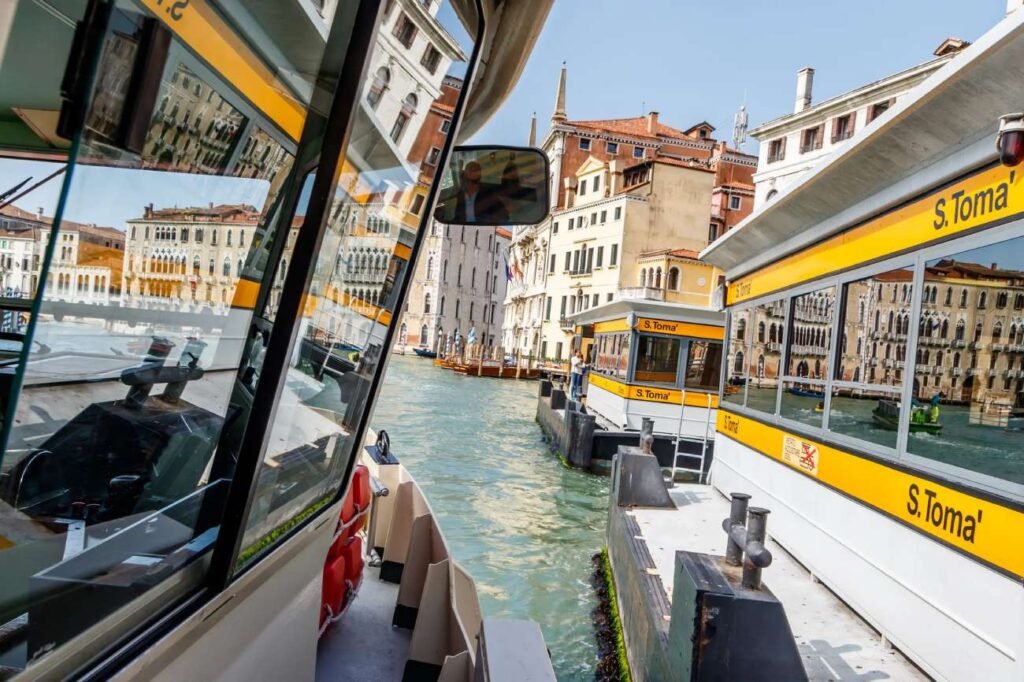
The word vaporetto literally translates to “little steamer.” While today’s fleet is powered by modern diesel, hybrid, or electric engines, the name stuck from the original steam-powered vessels. It is the primary form of public transport in Venice—essentially a floating bus. These sturdy, wide-hulled boats navigate the Grand Canal and the surrounding islands, carrying thousands of locals and tourists every hour.
2. A Quick Dip into History (Since 1881) 📜
The story of the vaporetto began in 1881. Before then, the Grand Canal was the exclusive playground of the gondoliers. Imagine the drama when the first mechanical boat, the Regina Margherita, chugged into the lagoon! The gondoliers actually went on strike, fearing for their livelihoods. However, the convenience won out, and by the early 20th century, the ACTV (Venice’s transport authority) was born, turning a luxury waterway into a public utility.
3. Is it the Best Way to Get Around? 🏆
Absolutely. While Venice is a “walking city,” the vaporetto is the best way to see the city’s “front door.” Venetian palaces were built to face the water, not the alleys. Taking the vaporetto saves you miles of walking over steep bridges and provides a vantage point you simply cannot get on foot. It is the perfect balance of efficiency and sightseeing.
4. Do I Need to Book Tickets Beforehand? 🎟️
Booking ahead is highly recommended. While physical ticket machines exist, they often have long queues in the sweltering heat. By booking online, you receive a digital QR code. This is essential because, on peak days, Venice implements access fees and crowd control; having your transport pre-validated allows you to bypass the chaos and scan your phone directly at the yellow readers.
| Vaporetto | Price | Tickets |
|---|---|---|
| 75-Minute | 12.00 € | Book Online |
| 24-Hour | 23.50 € | Book Online |
| 48-Hour | 40.00 € | Book Online |
| 72-Hour | 50.00 € | Book Online |
| 7-Day | 70.00 € | Book Online |
| + Murano + Burano | 37.00 € | Book Online |
| + Shuttle | 24.00 € | Book Online |
| + Water Taxi | 51.00 € | Book Online |
| + Ca’ Pesaro | 27.00 € | Book Online |
5. Understanding the Price Structure 💶
Venetian transport is a premium service. A single 75-minute ticket is an investment. However, the value lies in the Travel Passes.
6. How Many Lines are Operating? 🗺️
The network is vast, consisting of over 20 active lines. These are split into categories:
7. Operating Hours: The City That Never Truly Sleeps ⏰
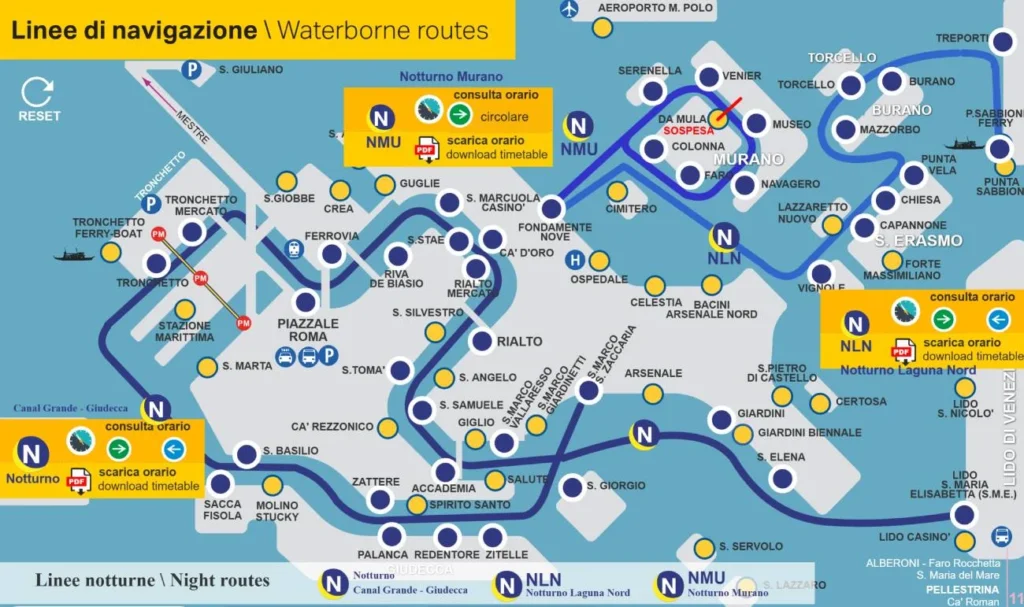
Most main lines run from 5:00 AM until Midnight. During peak hours (8:00 AM – 8:00 PM), boats on the Grand Canal arrive every 10 minutes. Even after the city quiets down, the Line N (Notturno) takes over, ensuring that no matter how late your dinner goes, you have a way back to your accommodation.
8. The “Secret” Night Line (Line N) 🌙
The Night Line is an experience in itself. It operates from roughly midnight until 5 AM. It follows a simplified route connecting the Train Station, Rialto, San Marco, and the Lido. Seeing the palaces illuminated and the water black and still is one of the most romantic things you can do in Venice—for the price of a standard ticket.
9. Navigating the Imbarcaderos (Boarding Stations) ⚓
An imbarcadero is a floating dock. Because they float, they move with the tide.
10. Line 1: The World’s Most Beautiful Route 🎨
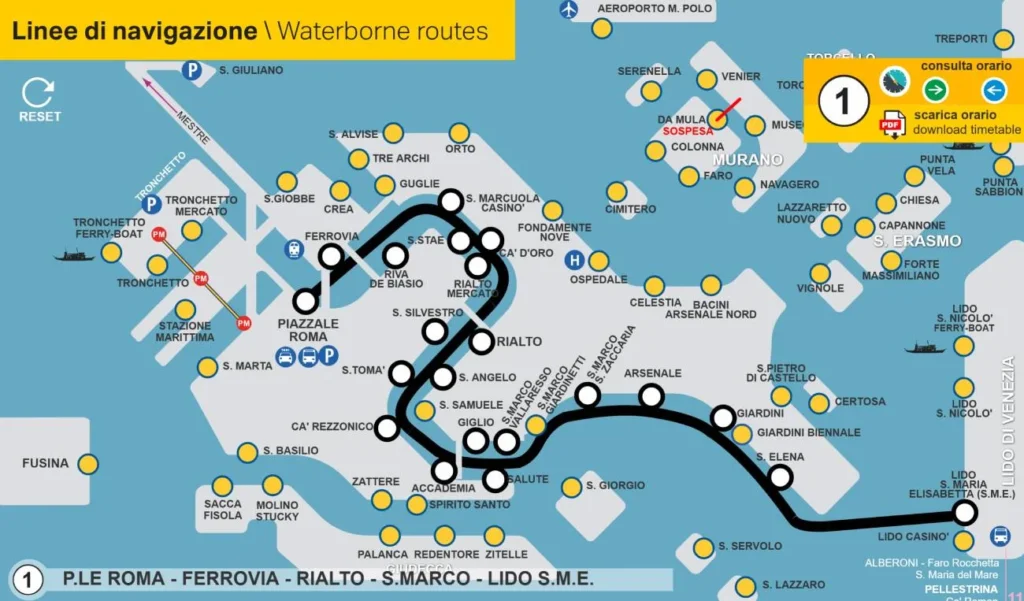
Line 1 is the “Slow Boat.” It stops at every single station along the Grand Canal. If you are a photographer or a first-time visitor, this is your line. It takes about 45 minutes to get from the Train Station to San Marco, but every second is a postcard-perfect moment.
11. Line 2: The Express Experience ⚡
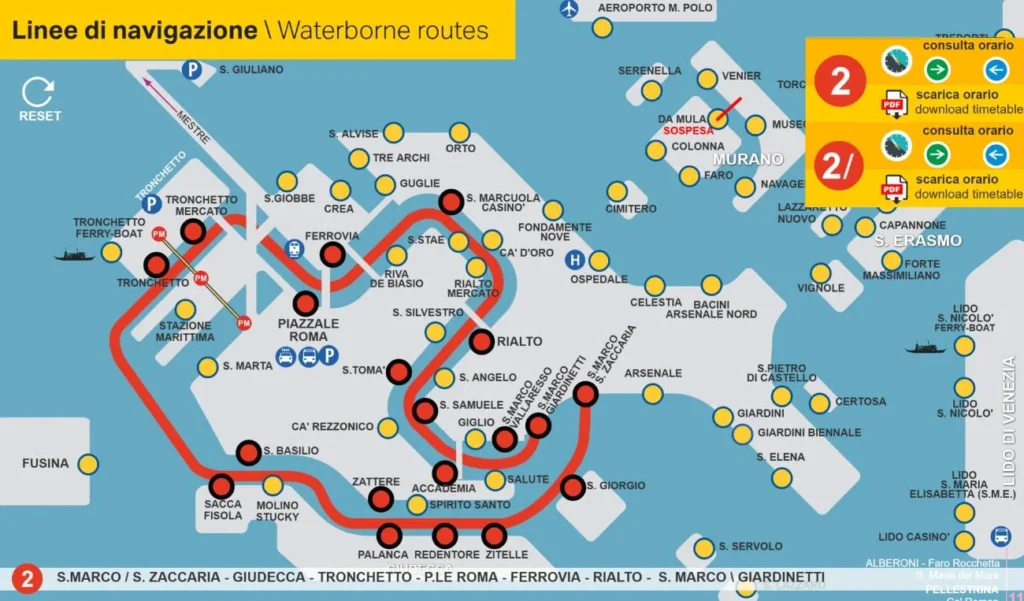
Line 2 is for the traveler on a mission. It skips the smaller stops like San Stae and Ca’ d’Oro, focusing on the major hubs. It is the fastest way to get from the parking at Piazzale Roma to the heart of the city.
12. Exploring the Islands: Line 12 🌈
To see the “other” Venice, you need Line 12. Departing from Fondamente Nove, this line whisks you away to:
13. The Lido and the Outer Lagoon (Line 14) 🏖️
If you’re visiting in the summer, Line 14 is your gateway to the beaches of the Lido. This line uses large motonave (big ships) that offer incredible panoramic views of the San Marco skyline as you sail away toward the Adriatic.
14. Vaporetto Etiquette: Travel Like a Local 👔
Venetians use these boats to get to work and buy groceries. To stay in their good graces:
15. Accessibility and Wheelchairs ♿
The vaporetto is the most accessible way to see Venice. While the city’s 400+ bridges are a nightmare for wheelchairs, the vaporettos are equipped with ramps. Sailors are trained to assist, and there is a designated spot on every boat for a wheelchair. Even better, the fare for a wheelchair user and one companion is significantly discounted!
16. The “Green Revolution”
Venice is fragile. The ACTV has introduced a significant number of E-Vaporettos. These boats run on electric propulsion in the smaller canals to prevent moto ondoso (wake pollution) from eroding the wooden piles that hold up the city. Traveling on an electric boat is nearly silent and much kinder to the environment.
17. Luggage Rules on Board 🧳
The standard ticket includes one large suitcase (up to 150cm total dimensions) and one small hand bag. If you are traveling with a heavy “Venice-wardrobe,” you may be asked to pay for an extra ticket for your luggage. Pro-tip: Keep your bags in the designated storage area near the entrance to stay out of the way.
18. Managing “Acqua Alta” (High Water) 🌊
During the winter months, if the tide rises too high, some vaporetto routes may be modified. High water can prevent boats from passing under certain bridges. If you see the sirens or hear the whistles, check the digital screens at the imbarcadero for “Variazioni di Percorso” (Route Variations).
19. Top 3 Most Iconic Stops 📍
20. Final Summary: Why the Pass is Your Best Friend 💎
The magic of Venice is the ability to get lost. With a pre-booked travel pass, you don’t have to worry about the cost of a “wrong” turn. If you get tired, you just hop on the next boat. It turns the transport system into a playground, allowing you to see Venice, Murano, and Burano with zero stress.