
Venice Vaporetto Schedule & Timetable Guide
Getting around Venice is an experience that defies the usual rules of urban transport. Here, there’s no underground metro or rubber-tired buses, but a fleet of sturdy boats battling tides and currents to keep the City of the Doges moving.
For the traveler, understanding vaporetto schedules is far more than a matter of punctuality: it’s a matter of logistical survival. 🕒🚤
Master the Canals of Venice
Navigate the floating city like a seasoned local. Explore real-time route frequencies, essential timetables, and comprehensive line guides for every water bus across the lagoon.
20+ Active Lines
Covering the Grand Canal, outer islands, and night service.
Frequency-Based
Most core lines run every 10–12 minutes without fixed wait stress.
🚢 Live Vaporetto Tracker by Line
Venice Vaporetto Timetable Overview
Quick reference guide for the first departures, last departures, and operational frequencies across the primary ACTV water bus lines.
| Line | First departure | Last departure | Frequency |
|---|---|---|---|
| Line 1 | ~05:00 | ~23:30 | 10–12 min |
| Line 2 | ~05:30 | ~23:30 | 12 min |
| Line 3 | ~06:20 | ~18:40 | 20–30 min |
| Line 4 | ~06:00 | ~21:00 | 20 min |
| Line 5 | ~05:45 | ~23:00 | 20 min |
| Line 6 | ~06:30 | ~19:30 | 20 min |
| Line 12 | ~04:20 | ~22:30 | 30 min |
| Line N | ~23:30 | ~05:30 | 30–60 min |
Venetian Time Philosophy: Why Fixed Schedules Are Rare
In Venice, if you ask a local for the exact time of the next boat, they’ll likely answer: “In five minutes.” The network runs on the principle of frequency-based scheduling rather than fixed timetables.
On main arteries like the Grand Canal, passenger flow is so high that ACTV doesn’t try to enforce a minute-precise schedule (which would be ruined by a delivery boat or a gondola traffic jam), but instead guarantees a constant interval.
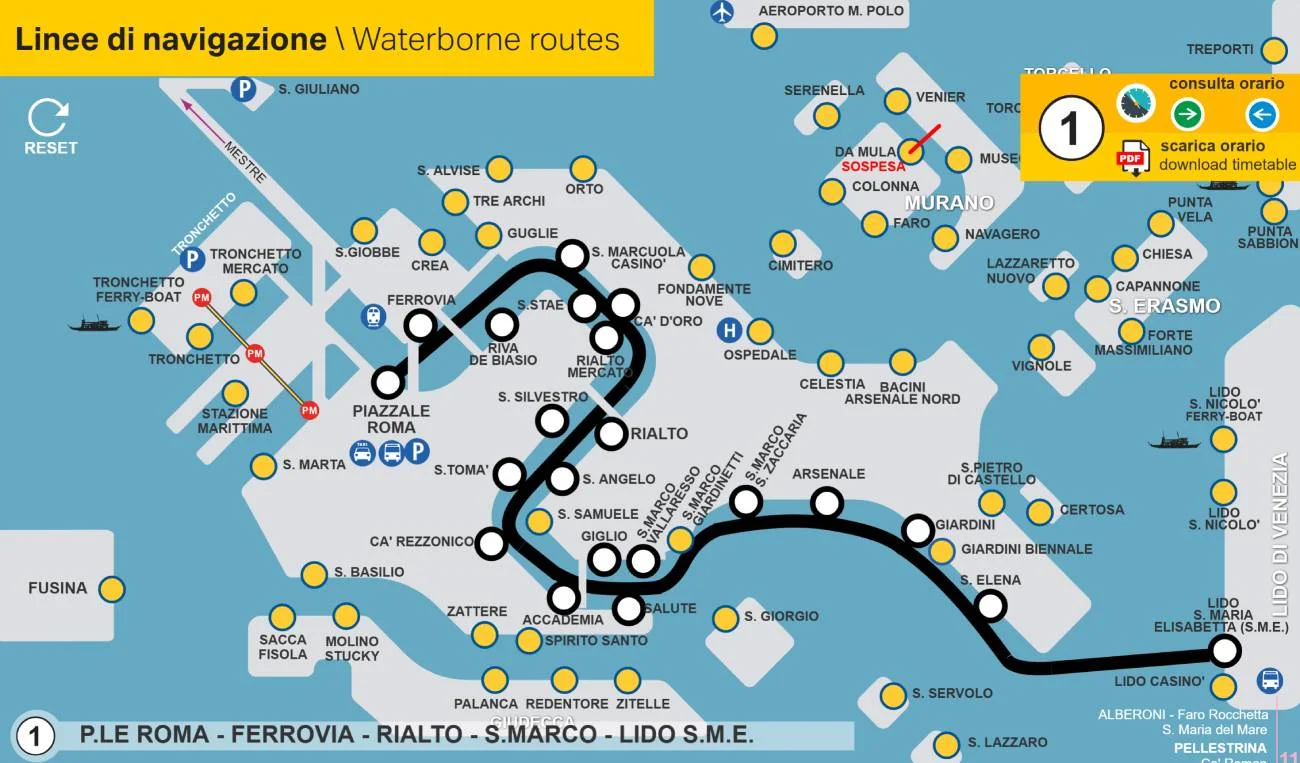
Line 1
The City’s Metronome
With a boat passing roughly every 10–12 minutes, Line 1 provides continuity of service that makes checking a timetable almost unnecessary.
 🔍 Click to enlarge map
The City’s Metronome
With a boat passing roughly every 10–12 minutes, Line 1 provides continuity of service that makes checking a timetable almost unnecessary.
🔍 Click to enlarge map
Line 2
The Brisk Rhythm
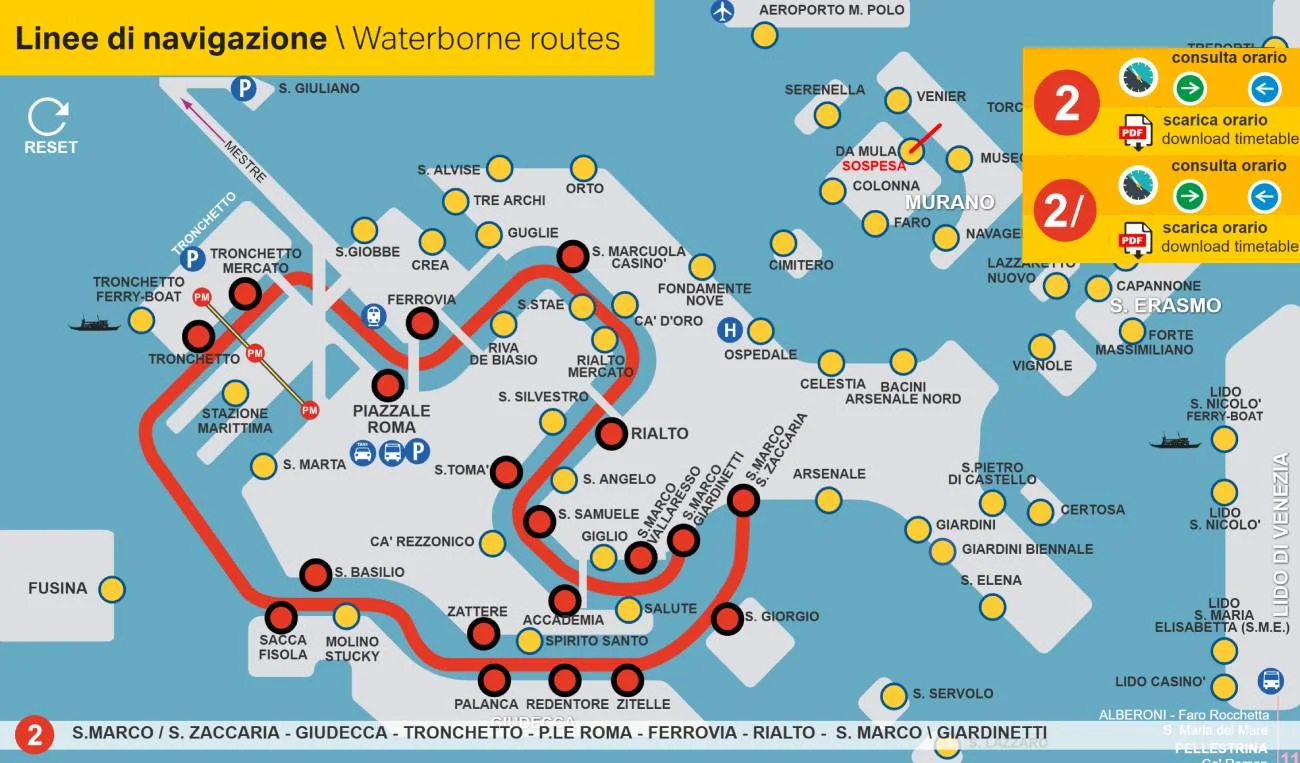
Line 2, more brisk and direct, runs on a steady 12-minute rhythm, connecting major hubs efficiently across the lagoon.
 🔍 Click to enlarge map
The Brisk Rhythm
Line 2, more brisk and direct, runs on a steady 12-minute rhythm, connecting major hubs efficiently across the lagoon.
🔍 Click to enlarge map
Line 3
The Murano Express
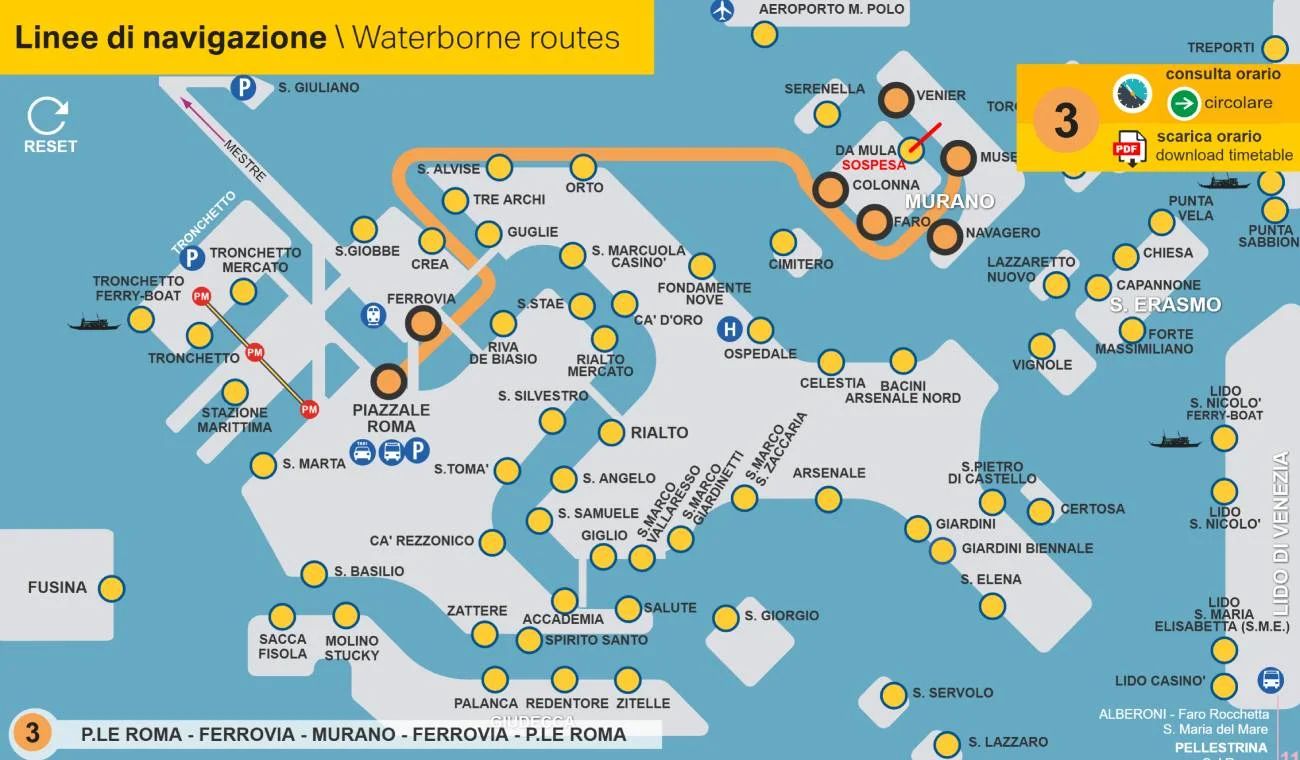
Line 3 provides a fast, direct connection between Piazzale Roma, the railway station, and Murano’s glass-blowing island, bypassing downtown crowds.
 🔍 Click to enlarge map
The Murano Express
Line 3 provides a fast, direct connection between Piazzale Roma, the railway station, and Murano’s glass-blowing island, bypassing downtown crowds.
🔍 Click to enlarge map
Line 4
The Northern Loops
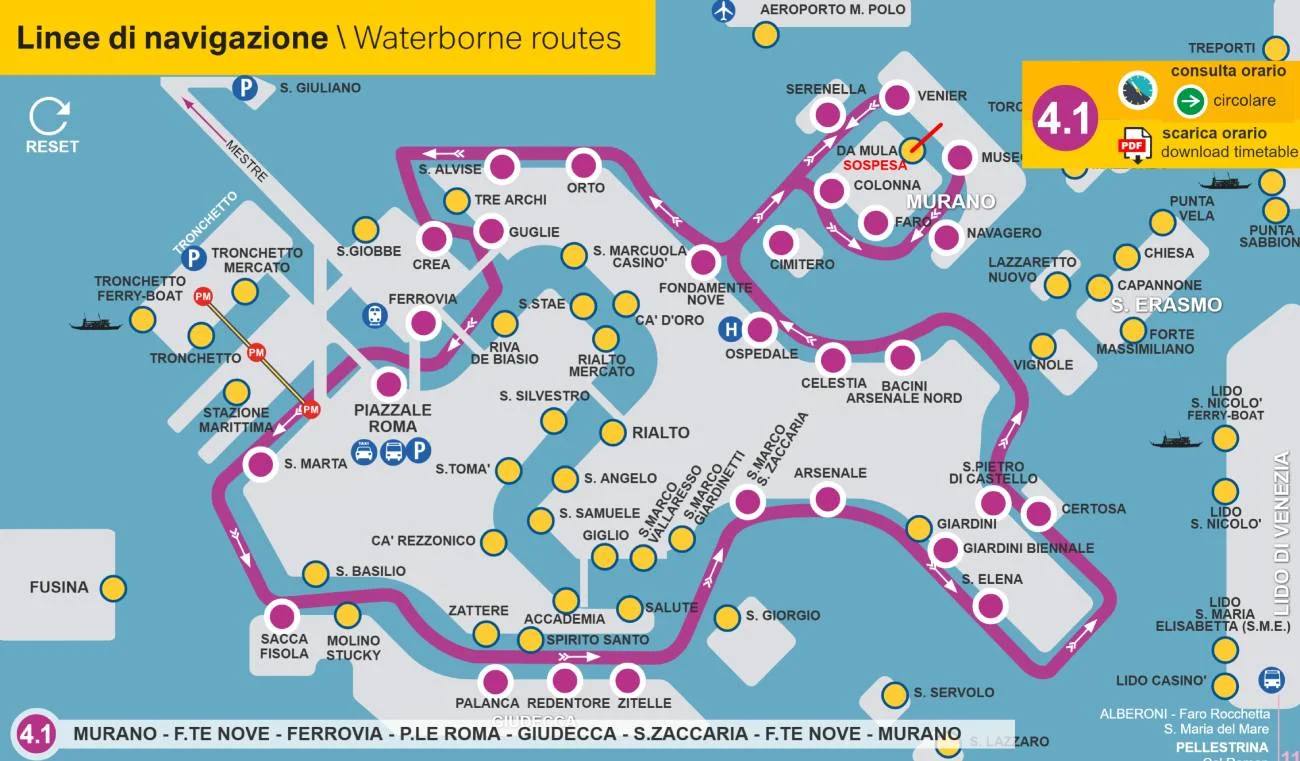
Line 4 (featuring counter-clockwise 4.1 and clockwise 4.2 services) circumnavigates the northern lagoon and Murano island.
 🔍 Click to enlarge map
The Northern Loops
Line 4 (featuring counter-clockwise 4.1 and clockwise 4.2 services) circumnavigates the northern lagoon and Murano island.
🔍 Click to enlarge map
Line 5
The Perimeter Loops
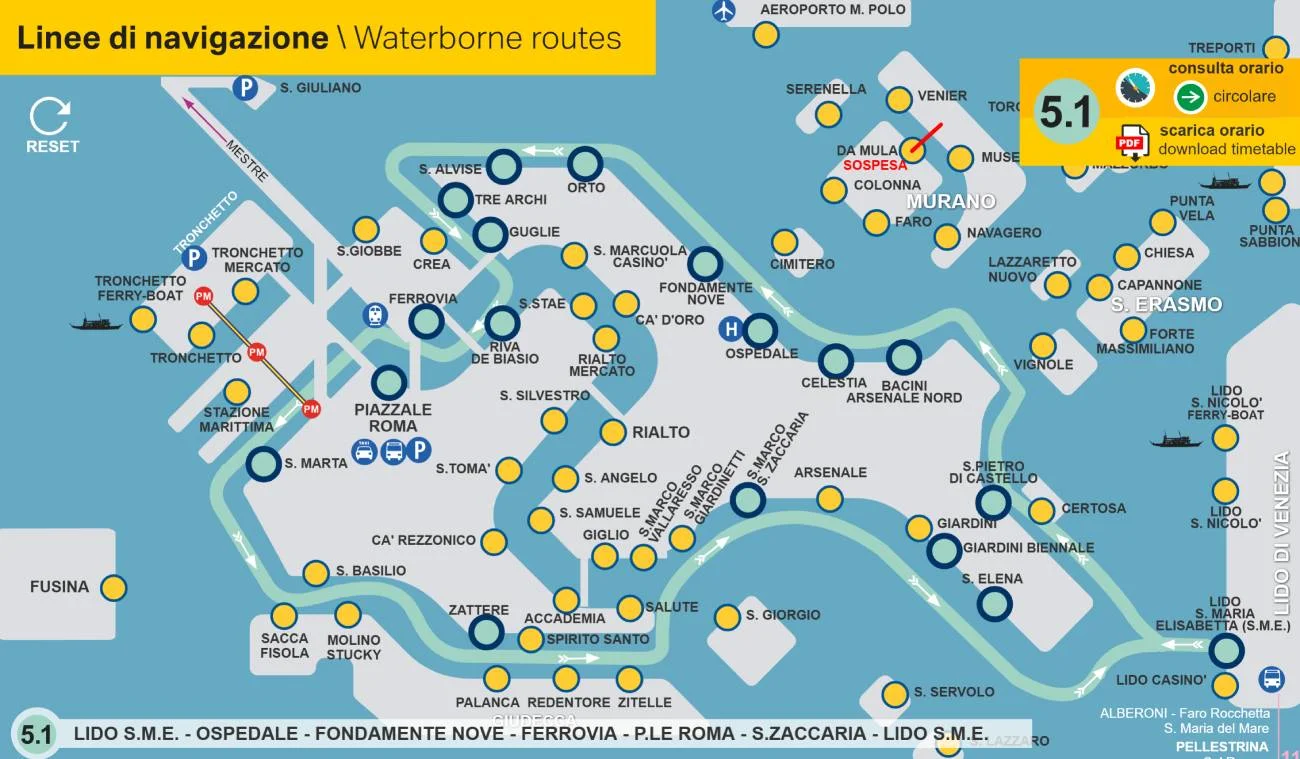
Line 5 (operating counter-clockwise via 5.1 and clockwise via 5.2) links peripheral city districts directly to the Lido.
 🔍 Click to enlarge map
The Perimeter Loops
Line 5 (operating counter-clockwise via 5.1 and clockwise via 5.2) links peripheral city districts directly to the Lido.
🔍 Click to enlarge map
Line 6
The Express Connector
Line 6 provides a fast, semi-direct seasonal service linking Piazzale Roma and the Zattere directly to the Lido, bypassing the inner Grand Canal.
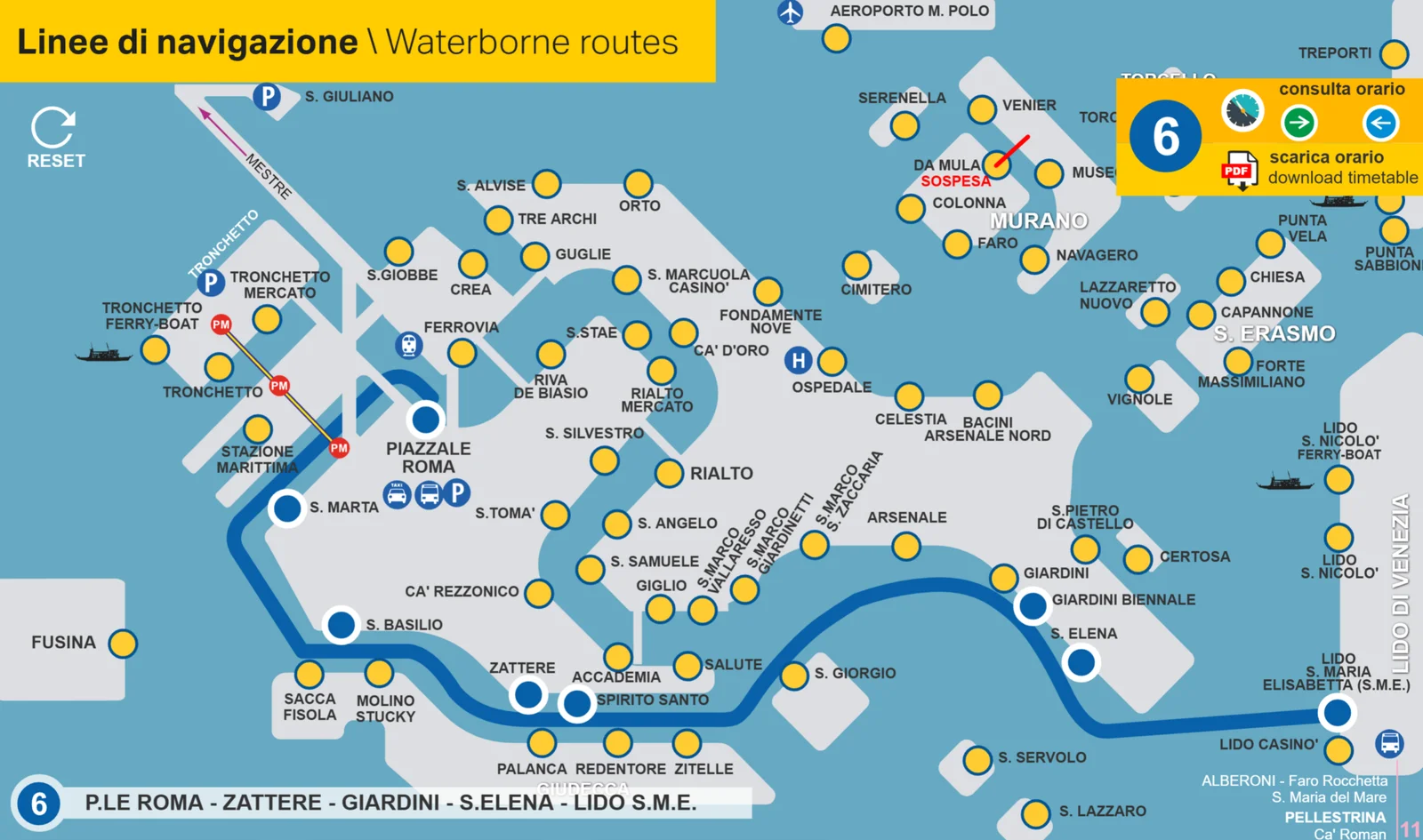 🔍 Click to enlarge map
The Express Connector
Line 6 provides a fast, semi-direct seasonal service linking Piazzale Roma and the Zattere directly to the Lido, bypassing the inner Grand Canal.
🔍 Click to enlarge map
Line 12
The Northern Lagoon Link
Line 12 serves as the essential maritime backbone connecting Fondamenta Nove to Murano, Burano, Torcello, and Punta Sabbioni.
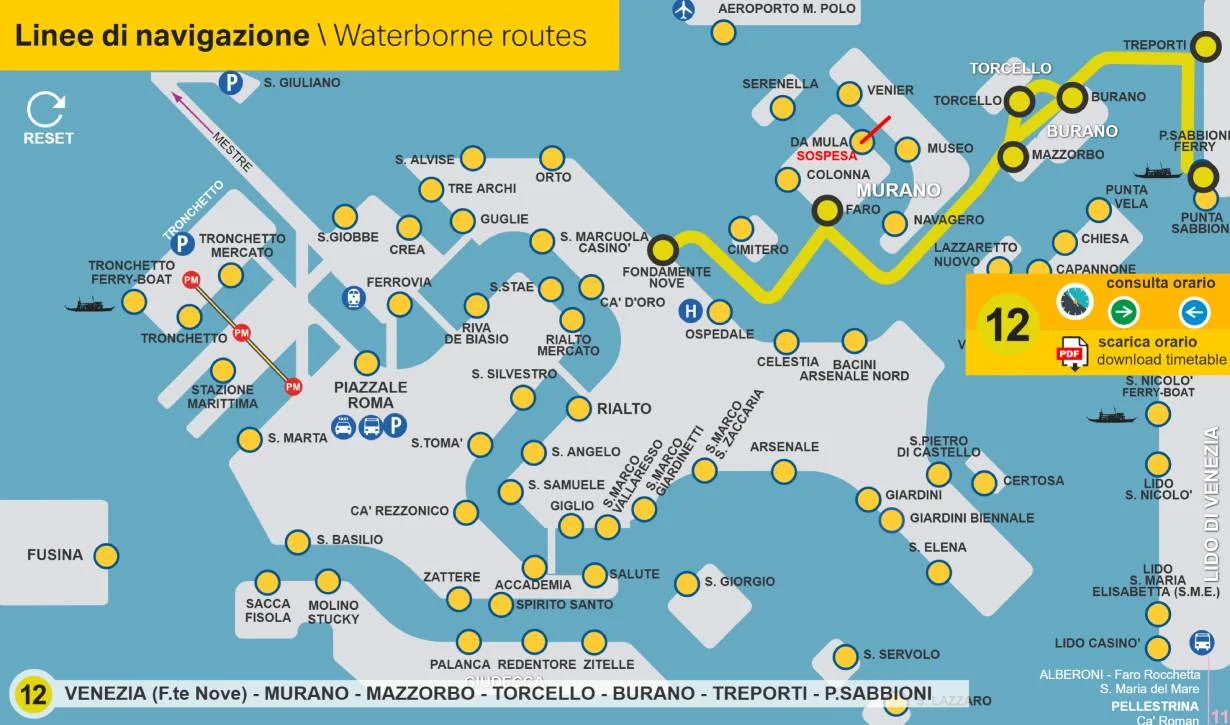 🔍 Click to enlarge map
The Northern Lagoon Link
Line 12 serves as the essential maritime backbone connecting Fondamenta Nove to Murano, Burano, Torcello, and Punta Sabbioni.
🔍 Click to enlarge map
📱 The AVM Venezia App: your co-pilot for getting around Venice
For optimal management of your trips, the AVM Venezia Official App is the essential tool to install on your smartphone before departure.
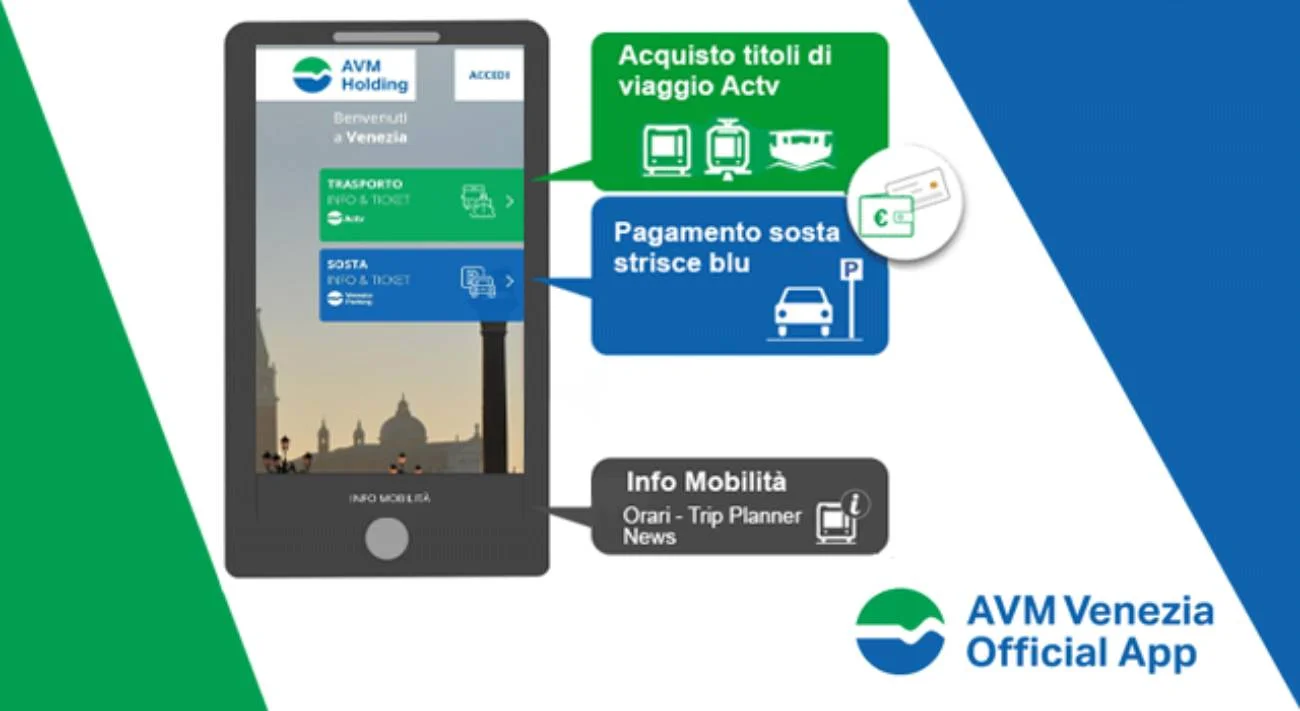
Digital Ticketing
Buy and validate your ACTV transport tickets directly from your phone, sparing you the need to find a physical ticket point or handle paper tickets.
Real-Time Trip Planner
Calculates precise routes in real time covering buses, trams, and of course, vaporettos across the lagoon network.
Live Logistics & Fares
Access official schedules, live traffic updates, and current fares — making it the most efficient tool for mastering Venetian transit in any situation.
The main phases of service: from dawn to the night transition
The vaporetto network never fully stops, but it changes character several times a day.
The lagoon wakes up
This is the most authentic moment. The first vaporettos carry Rialto market workers, hotel staff, and residents heading to work on the mainland. Frequencies are still moderate (every 20 minutes on Line 1).
Tourist and commuter peak
This is full-capacity mode. All lines are running, including reinforcement lines like Line 6 (Piazzale Roma–Lido) and Line 3 (Station–Murano). Frequencies are at their maximum.
Evening wind-down
From 8pm, some lines start shutting down. Line 6 stops, Line 3 disappears. Line 2 reduces its stops. If you’re dining across town, always check the last departure time. After 10pm, Line 1 often becomes your only option.
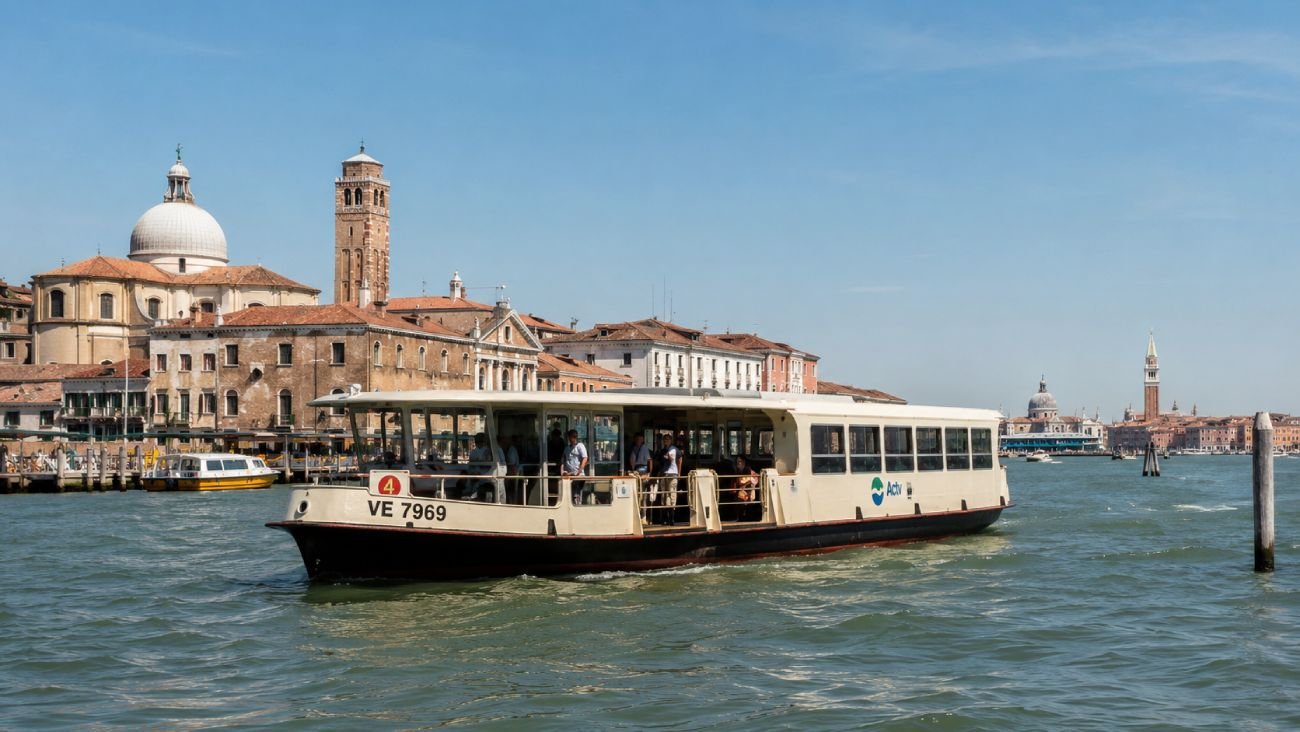
The night network (Line N): midnight magic
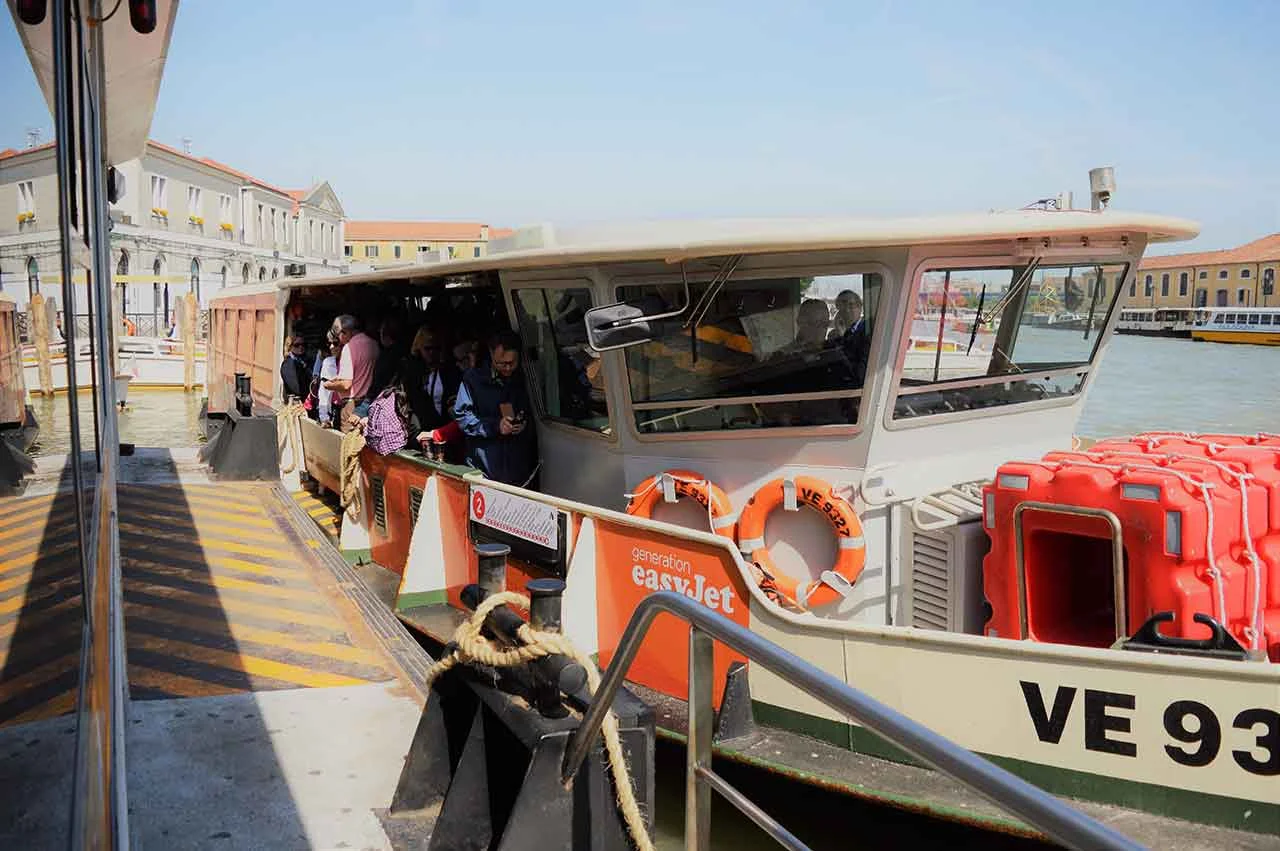
From around midnight, the “Giorno” (Day) service gives way to the Notturno (N) service — a dedicated fleet, often made up of smaller, more maneuverable boats.
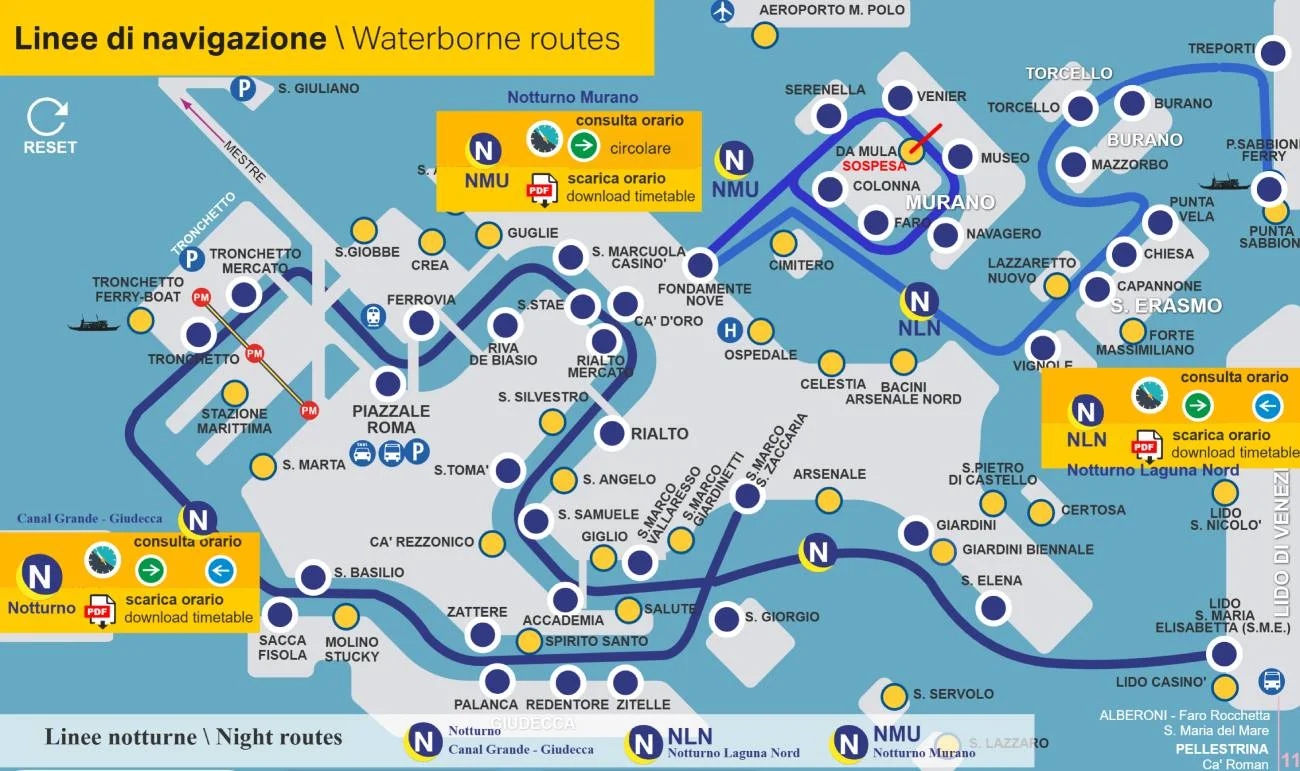
Line N is a logistical feat. It connects the Lido to Piazzale Roma, running the entire length of the Grand Canal with a detour via Giudecca.
Line N
Midnight Lagoon Transit
Operating as the vital nocturnal lifeline across the lagoon when standard daytime services wind down.
 🔍 Click to enlarge map
Midnight Lagoon Transit
Operating as the vital nocturnal lifeline across the lagoon when standard daytime services wind down.
🔍 Click to enlarge map
Choosing Your Pass: The Complete Venice Ticket Overview
Whether you are hopping across the Grand Canal just once or spending a full week exploring the lagoon islands, selecting the right tickets ensures seamless travel and maximum savings.
75-Minute Ticket
Ideal for a single point-to-point journey along the Grand Canal or a quick hop across the basin. Valid for 75 minutes from validation across the ACTV network.
24-Hour Pass
Perfect for whistle-stop day trips. Gives you unlimited rides for a full 24 hours from your first tap, covering central Venice and outer island routes.
48-Hour Pass
Tailored for weekend travelers. Explore Murano, Burano, and the historic center over two consecutive days without worrying about individual fares.
72-Hour Pass
The ultimate 3-day key to the lagoon. Breaks even after just 5 rides, offering total freedom across all ACTV water bus and mainland bus routes.
Holidays and Sundays: symbols to know
On the timetables, two symbols determine your fate:
Crossed Hammers
Valid Monday to Saturday — the full service, including lines for workers and students.
Cross
Valid Sundays and public holidays (January 1, April 25, May 1, etc.).
The Trap
On Sundays, Line 6 (the fastest route to the Lido) generally doesn’t run. Frequencies to Murano or Burano may also be slightly reduced. If you have a flight or train on a Sunday morning, don’t rely on your experience from the previous Friday.
Weather impact on schedules
Venice is an amphibious city, and weather dictates the engines.
Fog (Nebbia)
The worst enemy of schedules. In thick fog on the lagoon, lines to Burano and the Lido are hit first. Radar doesn’t solve everything — for safety, ACTV drastically reduces speed, and delays can pile up.
Acqua Alta (High Tide)
If the tide exceeds +120 cm, boats can no longer pass under certain bridges (notably the Rialto). The network gets “split”: Line 1, for example, will terminate at Rialto on one side and at the station on the other, unable to connect through.
Bora Wind
Can make docking difficult at exposed stops (like San Zaccaria or Fondamente Nove), slowing maneuvers by a few minutes at each stop.
The Vaporetto Reality Check: It’s Not Just a Hop-On Bus
It’s easy to treat the water bus like a standard city street bus—thinking you can just jump on board and hop off whenever you want. But the lagoon operates on its own rhythm.
The Mooring Math
Getting to the imbarcadero, waiting for people to exit the boat, and letting new passengers board takes real time. A vaporetto cannot simply swing open its doors and speed away instantly.
Always Be On Time
Because boarding sequences and lagoon traffic create cascading minor delays, missing your intended departure can set your entire itinerary back. Always aim to be at the dock early.
Pack Your Patience
Venice rewards those who slow down. Bring a healthy dose of patience for peak hours, crowded floating platforms, and the gentle, unhurried pace of island transit.
Conclusion: how to never miss your ride
To master vaporetto schedules, remember these three pillars:
Plan ahead
Buy your pass online to be ready from minute one.
Check
A glance at the digital dock signs beats any theory.
Buffer
Always keep a 15-minute safety margin if you have an important connection (train or flight).
Venice is a city that listens to itself and watches itself. Sometimes, missing a vaporetto is the best thing that can happen to you: it gives you ten more minutes to admire the sunlight reflecting off the Istrian stone of the palazzi. 🚤✨
Frequently Asked Questions About Venice Vaporetto Timetables
Everything you need to know about navigating ACTV water bus schedules, peak frequencies, and nighttime transit across the lagoon.
Do Venice vaporettos run on fixed minute-by-minute schedules?
On high-traffic central routes like the Grand Canal (such as Line 1 and Line 2), the network operates primarily on frequency-based scheduling rather than fixed timetables. Because water traffic and gondolas can cause minor delays, ACTV guarantees a constant interval rather than a rigid schedule. However, fixed schedules do apply to suburban and outer island lines.
What time do the vaporettos start and stop running each day?
Most daytime lines begin operations around 5:00 AM to 6:00 AM and continue running until approximately 11:30 PM to midnight. Once daytime services wind down, the night network (Line N) takes over to keep key connections open throughout the overnight hours.
How does the night service (Line N) work?
From around midnight, the Notturno (Line N) service replaces daytime routes. It runs from the Lido to Piazzale Roma along the Grand Canal and Giudecca. Departures occur every 40 to 60 minutes. Note that certain secondary docks may close overnight for maintenance, so always check for the “N” sign on the floating pontoon.
Do I need to check a timetable for Line 1 or Line 2?
Generally, no. Line 1 acts as the city’s metronome with a boat arriving roughly every 10 minutes, while Line 2 runs on a steady 12-minute rhythm. You can simply walk up to a dock along the Grand Canal without consulting a strict schedule. If you want to plan ahead, you can check individual tickets options or route guides.
Where can I find timetables for outer islands like Murano and Burano?
Outer island routes—such as Line 12 (connecting Fondamente Nove to Burano and Torcello) or Line 9—run on more fixed, scheduled intervals (typically every 30 to 50 minutes). Because these lines have fewer daily runs than Grand Canal routes, checking the specific timetable beforehand is recommended. Make sure you have valid tickets to cover all your island transfers seamlessly.
How frequent are the vaporetto departures during peak tourist seasons?
Major routes maintain tight intervals, with Line 1 running every 10–12 minutes and Line 2 running every 12 minutes. Express lines like Line 3 to Murano run every 20 to 30 minutes, ensuring high passenger throughput even during busy months.
Are vaporetto schedules affected by tides or weather conditions?
Extreme high tides (acqua alta) or severe weather can occasionally cause minor disruptions, bridge platform adjustments, or temporary deviations on specific low-clearance canal routes. Real-time updates are typically posted at ACTV docks.
Do timetables change between weekdays and weekends?
Yes. While core routes like Line 1 and Line 2 maintain consistent daily frequencies, certain specialized lines (such as Line 6 or holiday-specific seasonal routes) have altered operating hours or reduced schedules on Sundays and public holidays.
Can I rely on real-time schedule displays at the floating docks?
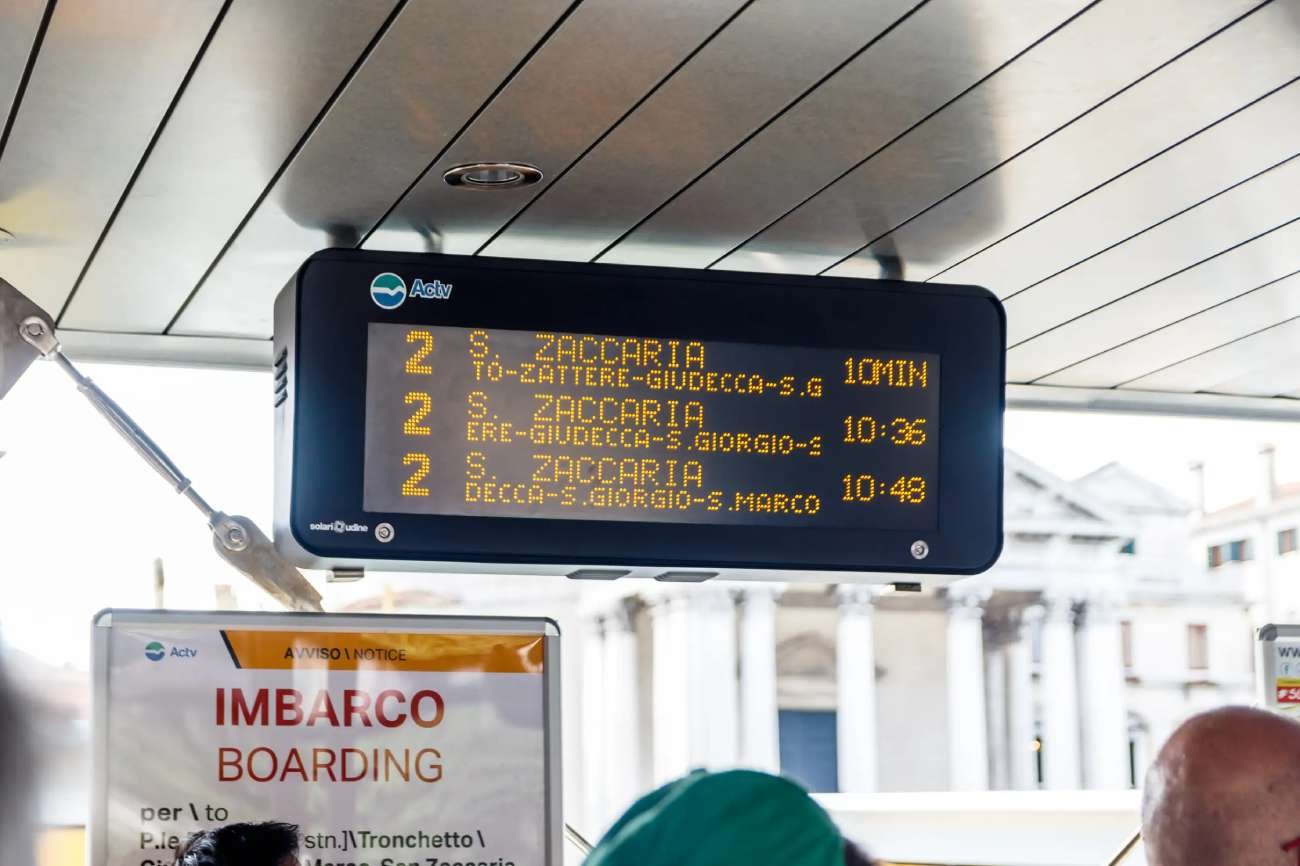
Many major ACTV stops feature electronic boards showing estimated arrival times for upcoming water buses. However, because of lagoon traffic variations, checking general frequency guidelines or having a 75-minute ticket handy helps keep your journey flexible.
How far in advance should I arrive at the vaporetto stop?
It is recommended to arrive at the floating pontoon about 5 to 10 minutes before your expected departure. Remember to validate your pass at the electronic turnstile or sensor reader before boarding the vessel.